


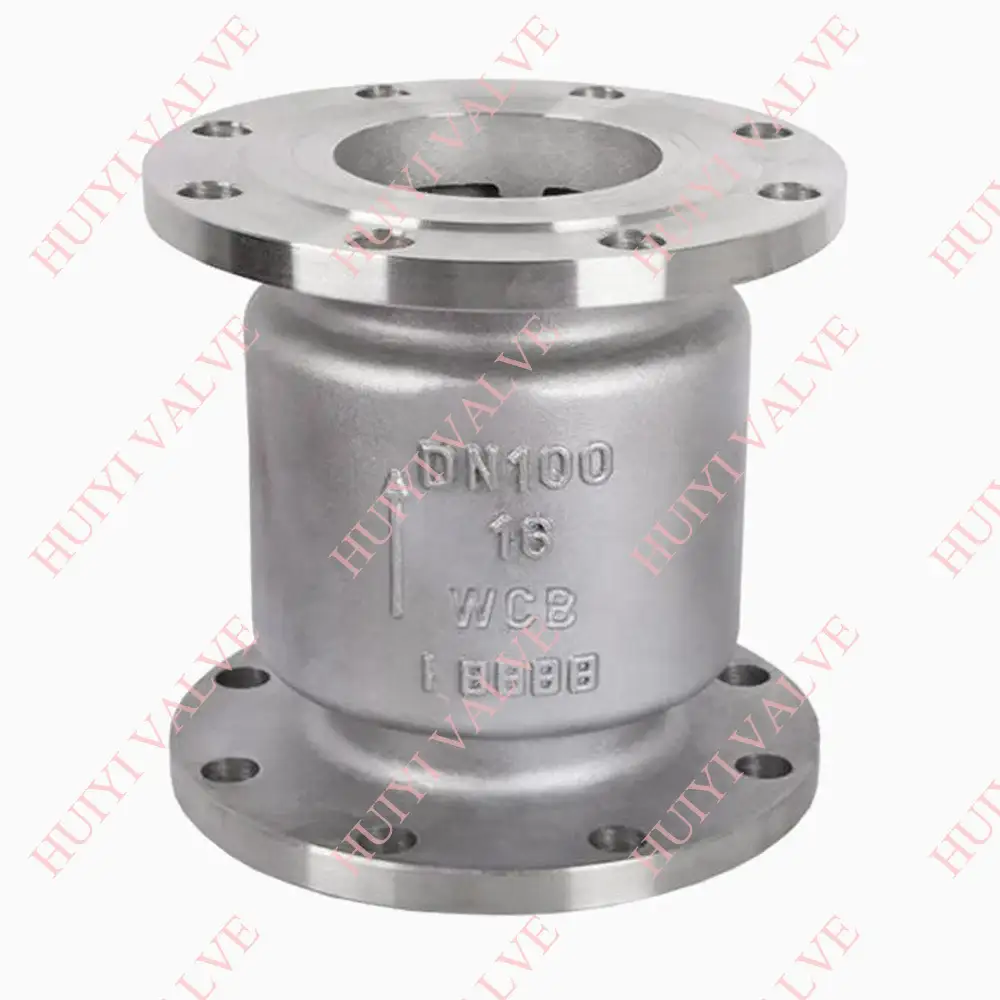
Flanged Lift Check Valve Stainless Steel 150 LB 2.5MPa API 594 Standard
Place of Origin:Zhejiang, China
Minimum order quantity: 20 pcs
Working Pressure: 150 LB, PN16, PN25, PN40
Working Temperature: normal temperature
Material: Stainless Steel, Carbon Steel
Packing: inner case is carton, outside package is plywood case
Delivery time: 7-25 days
Model:H42H
Customized Service: OEM, ODM
Medium: Oil, Gas, Water
Transaction mode: By sea, By air, By truck, By international express
Sealing: PTFE, VITON
Testing Standard: API 598
Guarantee Period: 12 Months
Product details
Size Table
PN16(1.6Mpa)
| Size | DN | 15 | 20 | 25 | 32 | 40 | 50 | 65 | 80 | 100 | 125 | 150 | 200 |
| L | MM | 105 | 105 | 105 | 150 | 160 | 170 | 180 | 200 | 210 | 275 | 300 | 380 |
| D | MM | 95 | 105 | 115 | 135 | 145 | 160 | 180 | 195 | 215 | 245 | 280 | 335 |
| Weight | KGS | - | - | - | - | - | 7.9 | 11 | 12 | 19.5 | 36 | 47 | 65 |
PN25(2.5Mpa)
| Size | DN | 20 | 25 | 32 | 40 | 50 | 65 | 80 | 100 | 125 | 150 | 200 |
| L | MM | 105 | 105 | 150 | 160 | 170 | 180 | 200 | 210 | 275 | 300 | 380 |
| D | MM | 105 | 115 | 135 | 145 | 160 | 180 | 195 | 230 | 275 | 300 | 360 |
| Weight | KGS | - | - | - | - | 7.9 | 11 | 12 | 20 | 38 | 48 | 70 |
PN40(4.0Mpa)
| Size | DN | 50 | 65 | 80 | 100 | 125 | 150 | 200 |
| L | MM | 170 | 180 | 200 | 210 | 275 | 300 | 380 |
| D | MM | 160 | 180 | 195 | 230 | 270 | 300 | 375 |
| Weight | KGS | 7.9 | 11 | 12 | 20 | 38 | 48 | 72 |
Main Parts Material
| Part Name | Material |
| Valve Body | CF8(SS304),CF8M(S316),Carbon Steel ASTM A216WCB |
| Disc | CF8(SS304),CF8M(SS316) |
| Sealing | PTFE |
Applications of Flange Vertical Check Valve: Ensuring Unidirectional Flow Reliability in Industrial Systems
In industrial fluid handling systems, unidirectional flow control is critical to preventing medium backflow, protecting equipment from damage, and ensuring the stability and safety of production processes. As a specialized valve designed for this purpose, the flange vertical check valve has become an indispensable component in various industrial fields due to its compact vertical structure, reliable backflow prevention performance, and excellent adaptability to high-pressure and high-temperature working conditions. This article elaborates on the core characteristics of the flange vertical check valve and explores its extensive applications across key industries, highlighting its vital role in optimizing fluid system operations and mitigating operational risks.
Core Characteristics of Flange Vertical Check Valve:
The flange vertical check valve is defined by its vertical installation orientation and flange connection design, which distinguish it from horizontal check valves and other types of non-return valves. The "flange connection" ensures a secure and leak-tight joint with pipelines, making it suitable for large-diameter pipelines and high-pressure applications—typically ranging from DN50 to DN1200 and pressure classes from PN10 to PN420. The vertical structure allows the valve disc to move up and down under the action of fluid pressure and gravity, enabling quick and automatic opening and closing without the need for external power sources, thus simplifying system design and reducing energy consumption.
A key feature of this valve is its reliable backflow prevention mechanism. When the fluid flows in the forward direction, the pressure pushes the valve disc upward to open the valve, ensuring unobstructed flow with low pressure loss. When the fluid stops or tends to flow backward, the valve disc falls rapidly under gravity and the reverse pressure, seating tightly against the valve seat to prevent backflow instantly. This rapid response minimizes water hammer effects—a common issue in fluid systems that can cause severe damage to pipelines, pumps, and other equipment. Additionally, the valve’s internal components, such as the valve disc and seat, are often made of wear-resistant and corrosion-resistant materials (e.g., stainless steel, alloy steel, or hard-faced materials), enhancing its service life in harsh industrial environments.
Key Application Scenarios of Flange Vertical Check Valve:
1.Water Supply and Sewage Treatment Industry
2.Power Generation Industry
3.Petroleum and Petrochemical Industry
4.Chemical Industry
5.HVAC and Industrial Boiler Systems
6.Marine and Shipbuilding Industry
Advantages of Flange Vertical Check Valve in Practical Applications:
Compared with other types of check valves, the flange vertical check valve offers several distinct advantages in industrial applications. Firstly, its vertical structure enables quick and automatic opening and closing, minimizing water hammer effects and protecting system equipment. Secondly, the flange connection ensures a secure and leak-tight joint, suitable for high-pressure and large-diameter pipeline applications. Thirdly, it has low pressure loss, which helps improve system energy efficiency and reduce operating costs. Fourthly, the use of corrosion-resistant and wear-resistant materials extends its service life in harsh environments. Finally, its compact design saves installation space, making it suitable for applications with limited space, such as offshore platforms and ship engine rooms.
FAQ